
Every structure, machine, or vehicle depends on secure connections to stay reliable and safe. Among the small but vital parts that make this possible are hex nuts—fasteners that secure bolts tight and components firmly joined.
To help you understand the significance of hex nuts and learn what to expect when negotiating with fastener suppliers, this article will dive into their applications and other relevant details, including the types available and the materials used.
What Are Hex Nuts?
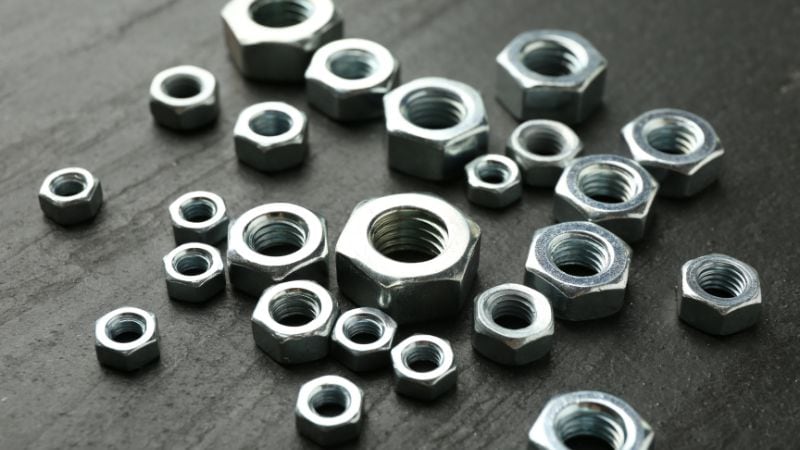
Hex Nuts: The Hexagon Fasteners for Bolts
A hex nut has a hexagonal threaded fastener with a hole running through the center that matches the bolt’s thread. This alignment ensures firm contact between the nut and bolt, creating a secure joint.
There are also variations like thin jam nuts, flange nuts, and nylon-insert lock nuts that adjust to particular performance needs such as space limits or vibration resistance.
Function and Mechanism
When tightened, the nut travels along the bolt’s threads, stretching the bolt. This stretching generates a clamping force within the bolt, which pulls the joined components tightly together. The primary force that resists separation is the immense static friction created between the surfaces of the clamped parts. The friction between the threads primarily helps overcome rotational forces and prevents the nut from loosening under vibration.
Torque, or rotational force, determines how tight the connection is. If properly torqued, the fastener resists loosening even under vibration or dynamic stress. Many assemblies also include washers beneath hex nuts to spread load pressure and protect surfaces.
Major Applications of Hex Nuts
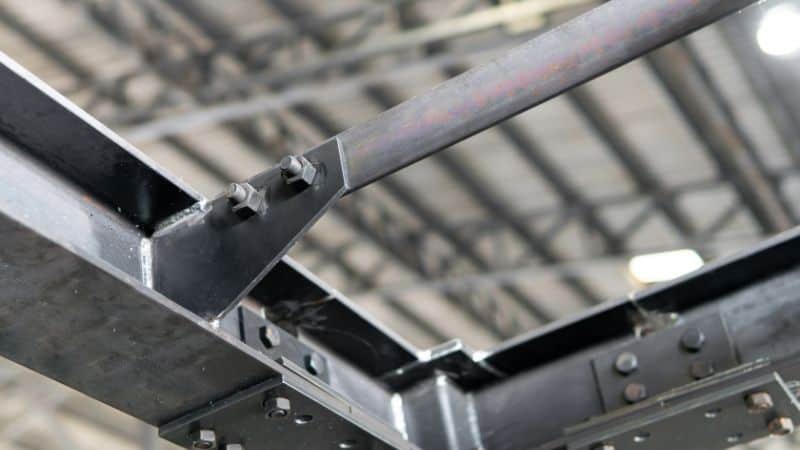
Construction and Structural Engineering
In construction and structural engineering, hex nuts secure steel beams, columns, and frameworks in buildings and bridges. The six sides of hex nuts allow workers to apply uniform torque using wrenches or sockets, which ensures proper tension and alignment.
Engineers often pair high-strength nuts with heavy-duty bolts on load-bearing structures. These fasteners help maintain stiffness in scaffolding, tunnels, and reinforced concrete forms. Also, using corrosion-resistant stainless steel can prevent rust in outdoor or coastal environments.
The ability to resist vibration and fatigue makes hex nuts reliable in both static and dynamic structural systems, including high-rise buildings and highway overpasses.
Automotive Industry
The automotive industry relies on hex nuts to fasten chassis frames, engine mounts, suspension systems, and brake assemblies. These parts face constant vibration and heat, which makes durable fasteners essential for safety and performance.
In motors and exhaust systems, stainless-steel nuts offer stability under thermal expansion. What’s more, self-locking or nylon-insert hex nuts are also common for preventing loosening under motion. These resist vibration and extend the lifespan of joints in both passenger and commercial vehicles.
As for quality standards, the nuts themselves must meet specific dimensional and mechanical property standards, such as ISO 4032. Furthermore, to supply the automotive industry, manufacturers are typically required to hold quality management system certifications like IATF 16949, which governs their production processes and ensures consistent quality.
Furniture Assembly
In furniture assembly, hex nuts provide firm joints for frames, tables, chairs, and storage units. They connect wood, metal, or composite materials with bolts to keep furniture stable during use.
Most household products use mild steel or brass hex nuts for ease of tightening and aesthetic appeal. Chrome or nickel plating helps prevent tarnish and improves appearance. This type of fastener allows for quick disassembly and reassembly, which suits flat-pack or modular furniture.
Types of Hex Nuts and Their Features
Standard Hex Nuts

Standard hex nuts, also known as hexagon nuts, are the most common type used in general fastening. Their six-sided shape allows equal wrench access from multiple angles, making installation and removal efficient. These nuts pair with bolts and screws of matching thread size and pitch for a secure fit.
Commonly zinc-plated for protection or indoor use, standard hex nuts are reliable where heavy vibration is not a concern but consistent torque and easy maintenance are needed.
Lock Nuts and Flange Nuts
Lock nuts use special designs to resist loosening under vibration. A nylon insert lock nut, often called a nyloc nut, contains a nylon ring that grips the bolt thread, preventing unintentional rotation.
This design is important in vehicles, engines, and moving machinery. For higher heat applications where nylon cannot withstand temperatures, all-metal lock nuts are often preferred.
Flange nuts include an integrated washer-like base that spreads pressure over a larger surface area. This reduces the chance of material damage and helps maintain even tension. They are widely used in piping systems, sheet metal assemblies, and exhaust components.
Both types aim to improve connection durability. Lock nuts ensure the joint stays tight under motion, while flange nuts protect surfaces and enhance load distribution.
Heavy Hex Nuts
Heavy hex nuts have thicker walls and a larger bearing surface than standard hex nuts. The added material increases strength and resistance to stress, making them suitable for heavy-duty structural work and equipment exposed to high loads.
Common materials include high-grade carbon steel or hardened alloy steel. Stainless steel versions are used when corrosion resistance is also necessary. These nuts pair with heavy hex bolts to provide secure joints in bridges, industrial machinery, and steel frameworks.
The extra thickness allows for greater thread engagement, which improves clamping force. In critical construction and power generation settings, their robust design ensures structural integrity and long-term reliability.
Choose the Right Materials and Grades for Hex Nuts
Hex nuts are made of various materials, and different types of nut applications heavily influence the material choice. This chapter breaks down your options to help you match the nut to your project’s demands with confidence.
Stainless Steel for Corrosion Resistance
Ideal for applications against rust, stainless steel hex nuts provide a robust barrier against moisture, chemicals, and weathering, ensuring long-term integrity with minimal maintenance.
- Grade 304 (A2): The go-to option for general-purpose use. It offers excellent durability resistance for most indoor, structural, and machinery applications. For example, building frames, factory equipment, and standard fastening jobs.
- Grade 316 (A4): Suitable for marine and chemical industries. Enhanced with molybdenum, Grade 316 resists pitting from chlorides and acids. It is best for marine hardware, coastal construction, chemical processing plants, food-grade equipment, etc.
- Duplex & Super Duplex: Designed for heavy-duty. When you face extreme conditions and need high strength—like in chloride-rich environments—these grades excel. They are the top choice for offshore platforms, seawater pipelines, and wastewater treatment systems.
| Grade | Best For | Key Customer Benefit |
|---|---|---|
| 304 (A2) | General construction, machinery, indoor uses | Cost-effective rust resistance for most jobs |
| 316 (A4) | Saltwater, acids, chemical exposure | Maximum durability in harsh, wet environments |
| Duplex | Offshore, high-pressure corrosive systems | Unmatched strength & corrosion resistance combined |
Carbon Steel for Strength and Cost Efficiency
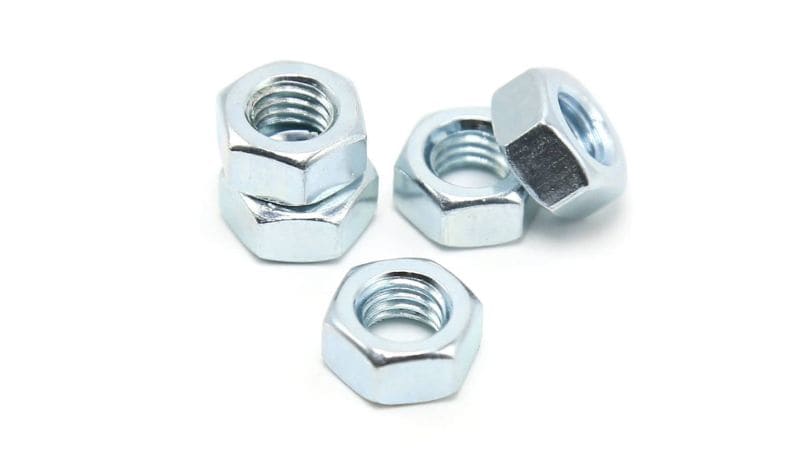
Carbon steel nuts deliver good tensile strength while ensuring budget efficiency. They are the backbone of the automotive, structural, and heavy equipment industries.
Their properties are defined by grade classifications (common in systems like SAE J995 or ASTM A563), which correspond to specific strength levels:
- Grade 2: Low carbon, general use.
- Grade 5: Medium carbon, heat-treated.
- Grade 8: High strength, for critical, high-stress applications.
Unlike stainless steel, bare carbon steel can still rust, which necessitates protective coatings:
- Zinc-Plated: A shiny, economical barrier against rust.
- Black Oxide/Phosphate: Provides a darker finish with good corrosion resistance and reduces friction during tightening.
- Hot-Dip Galvanized: A thick, rugged coating for outdoor structures, fencing, and industrial use.
Alloy Steel Variants: Infused with elements like chromium or nickel for enhanced toughness, wear resistance, and performance in high-temperature settings.
Brass, Titanium, and Specialty Alloys for Unique Challenges
There are other materials that solve specific problems when standard steels do not suffice.
Brass Nuts: Conductive & Non-Sparking.
- Perfect for: Plumbing fixtures, electrical connectors, and decorative hardware.
- Key Benefits: Naturally corrosion-resistant, excellent electrical conductivity, and non-sparking—a critical safety feature in flammable atmospheres (e.g., fuel lines, chemical plants).
Titanium Nuts: High Strength-to-Weight.
- Perfect for: Aerospace, high-performance automotive, marine rigging, and medical implants.
- Key Benefits: Incredibly strong yet half the weight of steel, with superb corrosion resistance. It’s for applications where weight reduction and reliability are both required.
Super-Alloys (e.g., Hastelloy, Inconel): These alloy nuts are designed for the most extreme conditions, including high-temperature reactors, concentrated acid processing, and aggressive chemical environments where even stainless steel may falter.
The Decision Checklist: How to Choose
-
What is the environment? (Indoor, outdoor, marine, or chemical?)
-
What are the strength requirements? (Static load vs. dynamic stress?)
-
Are there weight or conductivity needs? (Aerospace vs. electrical?)
-
What is the budget? (Balance upfront cost with lifecycle cost—a cheaper nut that rusts is expensive to replace.)
Find Customized Hex Nuts at Oukailuo
By understanding these core material properties, you can specify hex nuts that ensure safety, durability, and value for your specific application. Need help determining grades or sourcing hex nuts for your project? Our teams with the abilities to both design and manufacture are here to assist.
At Oukailuo, we have built up extensive expertise through 25+ years of practice in fastener manufacturing. Our skilled R&D and QA team can meet all your customized needs with quality OEM & ODM services. Contact us today to explore your customized fastener solutions!
Frequently Asked Questions (FAQ)
Can a hex nut be reused, or should it always be replaced?
While standard hex nuts can often be reused if undamaged, it is critical to replace nuts in safety-critical or high-vibration applications. For lock nuts, caution is advised. Nylon-insert lock nuts see their locking effectiveness reduced after initial use, and many manufacturers recommend single-use only for optimal performance in secured joints. Always inspect threads for wear, corrosion, or deformation, and consult the manufacturer’s specifications before reusing any lock nut.
Are there left-handed hex nuts?
Yes. Although most hex nuts have right-handed threads (tighten clockwise), left-handed thread nuts (tighten counter-clockwise) are indeed used in specific applications where rotational motion might loosen a standard right-handed nut, such as on the left side of bicycle pedals or certain rotating machine components.
Where is the best place to purchase hex nuts for a specific project?
For personal or household uses, hardware stores are sufficient. However, if you are looking for hex nuts with specialized applications, grades, materials, or certifications, and wish to purchase in bulk without worrying about uncertain lead times or inconsistent product quality, then industrial suppliers like Oukailuo are highly recommended.