
Within the broad spectrum of fasteners, pins are on the simpler side because of their plain structure. However, they still play a key role across countless projects and machines. From basic safety pins to precision dowel and locating pins, each type is designed for a specific purpose.
In this guide, we at Oukailuo will offer your industrial knowledge on pin types based on different criteria, as well as how to choose from different types of pins, so that you can choose the right ones that are suitable for applications you desire.
Basics of Pin Fasteners: Definition & Main Pin Types
What Are Pin Fasteners?
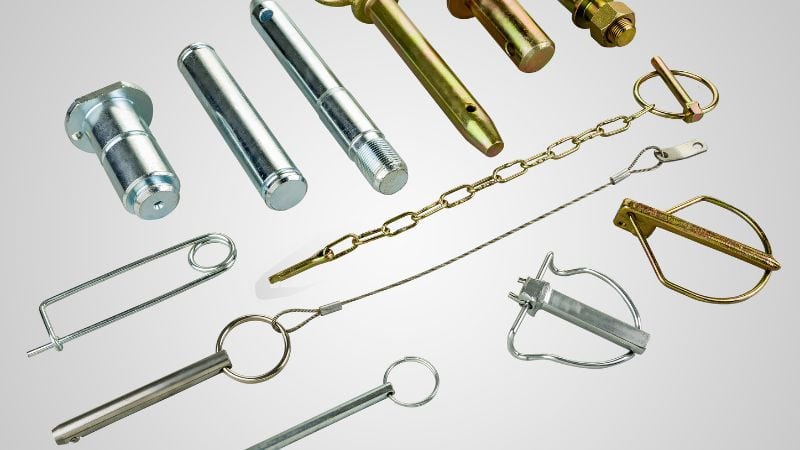
A pin fastener is a simple, cylindrical or tapered metal component used to secure, align, or join two or more parts. It is inserted through matching holes and may rely on friction, locking features, or other retaining methods.
Pins are often used in making robust assemblies. Their function can be categorized into three major aspects:
- Alignment: Dowel and taper pins ensure exact positioning between mating parts.
- Locking and securing: Cotter and hitch pins prevent nuts, bolts, or shafts from loosening.
- Load transfer: Some pins transmit shear forces between components in mechanical assemblies.
Permanent vs. Semi-Permanent vs. Quick Release Pins
Pin fasteners can be grouped by how easily they can be removed or replaced:
Permanent pins create stable, precise joints in equipment where movement or vibration must not shift parts.
Semi-permanent pins allow for maintenance access while keeping components secure during use.
Quick-release pins feature spring balls, handles, or locking rings for fast and tool-free changes, widely used in agricultural and transport machinery.
| Type | Typical Use | Removal Difficulty |
|---|---|---|
| Permanent Pins | Long-term connection | Hard to remove without damage |
| Semi-Permanent Pins | Occasional disassembly | Can be removed but require tools |
| Quick Release Pins | Frequent adjustments | Easily removable by hand |
Types of Pins for Positioning and Alignment
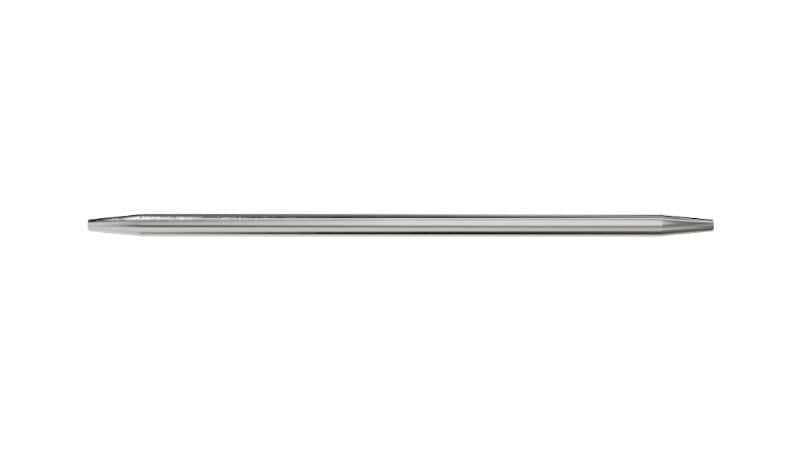
Dowel Pins
Dowel pins are solid, cylindrical machine pins used to ensure exact alignment between joined components. They are typically made of hardened steel pins or stainless steel for corrosion resistance.
They are pressed into precision, aligned holes in both components, creating a tight fit that prevents movement. This requires the holes to be drilled and reamed together or with high positional accuracy.
Common uses include tool and die setups, engine assembly, and fixture alignment. Their tight tolerances help maintain repeatable positioning when parts are disassembled and reassembled.
Taper Pins
Taper pins are precision machined pins that narrow slightly along their length. This shape creates a controlled interference fit when pressed into reamed holes, allowing strong, vibration-resistant connections.
They are common in machine tool construction, automotive fixtures, and aerospace systems. Because their fit tightens as they seat, they are ideal for applications where alignment must remain stable under stress or repeated motion.
Groove Pins
Groove pins, sometimes called grooved dowel pins, have longitudinal grooves cut along the shaft. These grooves compress slightly during installation, locking the pin securely in its hole through friction and material displacement.
Unlike smooth dowel pins, groove pins allow easier insertion while maintaining a firm hold. They are often used in light machinery, electronic assemblies, and consumer products due to their balance of strength and flexibility.
Most are made from carbon or stainless steel. Some designs include full-length or half-length grooves, each offering different retention characteristics. Because they resist loosening from vibration without needing extra hardware, groove pins serve as a reliable fastening option in compact designs.
Fastening and Locking Pins
Cotter Pins
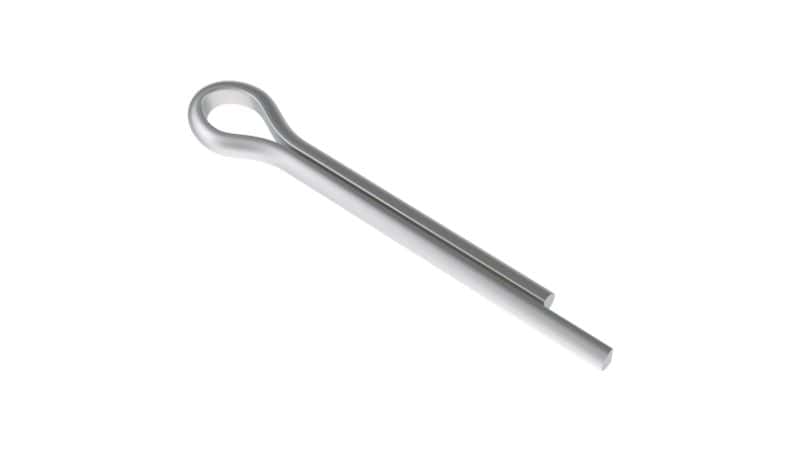
Cotter pins are split metal fasteners shaped like a looped wire with two legs. After being inserted through a hole, the legs are bent outward to lock the pin in place. This simple action prevents nuts, bolts, or clevis pins from loosening during operation.
They are typically made from stainless steel, carbon steel, or brass, offering choices based on required strength and corrosion resistance. Common uses include securing wheel bearings, machinery shafts, and automotive assemblies.
For finishing, pins come either plain or with a zinc plating, which provides an added layer of protection against rust and corrosion in demanding environments.
They are removed by straightening the legs and sliding the pin out, which makes maintenance fast without damaging components.
Clevis Pins
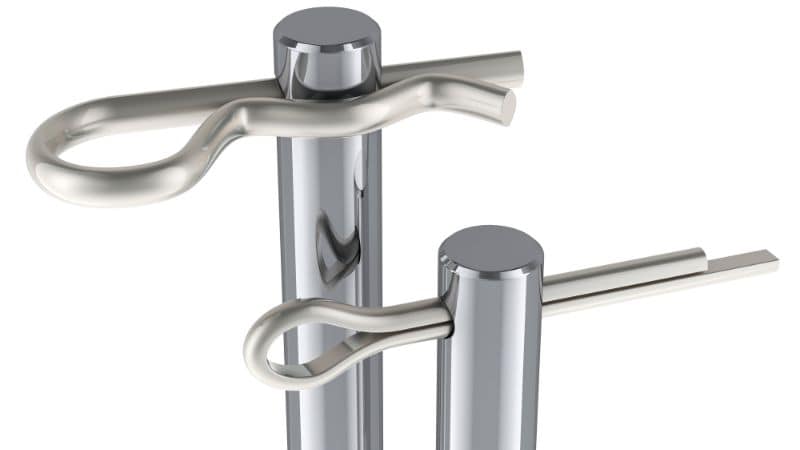
A clevis pin functions as a removable hinge or pivot. It features a cylindrical shaft with a cross-drilled hole for a cotter pin or retaining clip. This system typically consists of a clevis (a U-shaped fork), a clevis pin passed through the holes in the clevis legs, and a cotter pin or R-clip inserted through a hole in the clevis pin to secure it.
Manufacturers often use hardened steel or stainless steel for strength under shear loading. Industries such as construction, agriculture, and aerospace rely on clevis pins because they support heavy mechanical motion while remaining easy to replace.
Spring Pins
A spring pin is a hollow, cylindrical fastener designed to compress as it is inserted into a hole and then expand to hold securely. This self-locking feature allows for quick assembly and reliable alignment in moving or vibrating parts. Common materials include carbon steel, stainless steel, and alloy steel, chosen for their strength and corrosion resistance.
They are widely used in automotive, machinery, and electrical equipment assemblies. Engineers value them for reducing wear on holes, as their spring-like structure absorbs shock and distributes loads evenly. Compared to solid dowels, spring pins are lighter, cheaper, and easier to replace if damaged.
Spring pins come in different configurations to meet specific fit and strength requirements. Common types include rolled spring pins (often called roll pins) and straight slotted spring pins, each offering different spring characteristics and load distributions.
Specialty and Quick-Release Pins
Quick-Release Pins
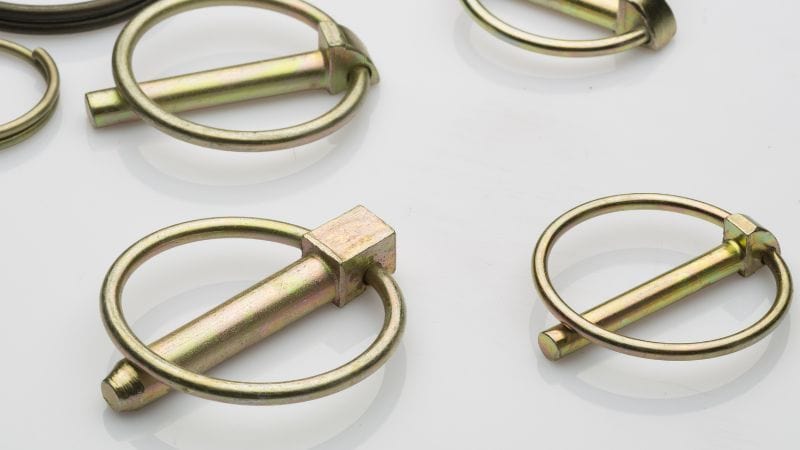
Quick-release pins allow for instant insertion and removal by hand, using a built-in locking mechanism. They are essential in equipment that needs rapid part changes, such as agricultural attachments, aerospace tooling, and manufacturing jigs.
- Ball Lock Pins (Push-Pull Pins): The most common type. A spring-loaded button retracts locking balls at the pin’s tip for insertion/removal. Releasing the button lets the balls expand, locking the pin securely in place. They offer excellent vibration resistance.
- Lynch Pins & Hitch Pins: These feature a spring-loaded ring or clip that snaps into place. Common on trailers and tractor implements, they provide a very fast, visual locking method.
- Detent Pins: A simpler version using a spring-loaded ball bearing that snaps into a recess. They provide light retention for telescoping parts, adjustable linkages, or temporary positioning.
Handle styles (T-handle, L-handle, ring-handle) are often added to these pins for better grip and leverage, especially when wearing gloves or working in tight spaces.
Specialty Latching and Locking Pins
These pins serve specific functions beyond simple fastening, often incorporating unique mechanisms for safety or controlled release.
- Retractable Spring Latch Pins: These function like a plunger. Pulling a handle or knob retracts the pin completely, allowing a part to move or detach. Releasing it locks the pin in the extended position. Ideal for securing panels, gates, or access doors that need to be opened and closed regularly.
- Wire Lock Pins: These combine a straight pin with a spring wire loop that snaps into a groove. The wire provides flexible, vibration-resistant retention and is easy to operate by hand. Often used in marine, aerospace, and heavy equipment for critical safety-related connections.
How to Choose from Different Types of Pins
Define the Primary Function
First, you need to have a set of specific requirements in functions. This will narrow down the catalogue significantly.
- Alignment & Positioning: The primary function here is precise alignment. Choose dowel pins, taper pins, or groove pins. These fasteners are designed for precise positioning and ensuring components remain in place.
- Securing & Locking: Look at fasteners like the cotter pin (for safety-wiring), clevis pin (for pivot joints), or spring pins (for vibration resistance). These pins are used to hold components securely.
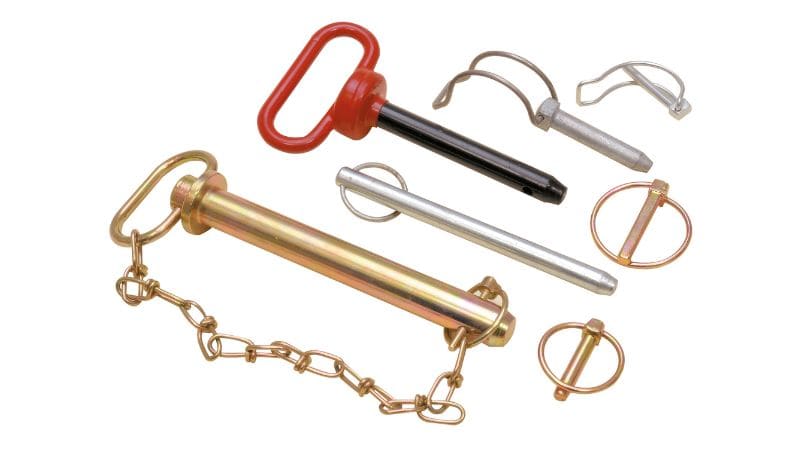
- Installation & Removal: Quick-release pins such as lynch pins, hitch pins, detent pins, and L-handle pins are designed for tool-free operation. Wire lock pins also fall into this category, offering secure, quick release.
Select the Appropriate Material
Pin materials determine strength, weight, durability, and environmental resistance. Most pins are made from durable metal pins, with steel pins being commonly used. Match the material to your operating conditions.
| Material | Key Advantages | Ideal For |
|---|---|---|
| Carbon Steel | High strength & hardness, cost-effective; often improved via heat treatment. | General machinery, high-shear applications. |
| Stainless Steel | Excellent corrosion resistance, good strength. | Marine, food processing, chemical, and outdoor applications. |
| Aluminum | Lightweight, good conductivity. | Aerospace, electronics, where weight is critical. |
| Brass | Good corrosion resistance, non-sparking, decorative. | Electrical fittings, architectural details. |
Key Consideration: For harsh environments, combine an inherently resistant material with a protective finish for maximum longevity.
Evaluate Key Performance Properties
Assess the demands the pin fastener must withstand in various settings.
- Shear Strength: This is the primary load for most pins. Calculate the lateral force the pin must endure.
- Corrosion Resistance: Critical for outdoor or chemical-exposed applications.
- Fatigue Resistance: For moving parts, choose pins with locking features. Spring pins and groove pins resist loosening under vibration.
Factor in Manufacturing & Quality
Precision is non-negotiable for alignment and fit. Most pins are cylindrical, and their quality depends on the manufacturing process.
- Tolerances: Precision-ground pins are essential for accurate locating. Processes like CNC machining or grinding ensure tight tolerances.
- Surface Finish: A smooth finish ensures easier installation. Secondary processes can also improve properties.
- Quality Assurance: Source from manufacturers with rigorous quality control, industrial certifications are the best proof for a manufacture’s expertise and production capacity.
Customized Pin Fastener Solutions at Oukailuo
Although this guide has covered the major variations of fastener pins, fasteners used for different applications usually need customized designs and competent manufacturers for reliable and high-quality results.
Here at Oukailuo, we meet your needs for customization with OEM & ODM capabilities with over 25 years of fastener manufacturing experience. Contact us and discuss the specifications of your projects today!